


When you're preparing for an international move, it's easy to focus on packing boxes and booking a removal company. However, one of the most useful things you can do before moving day is to create a detailed moving inventory.
A well-organised inventory isn't just a list of your belongings. It helps you keep track of everything you're taking, makes unpacking much easier and provides valuable documentation if you ever need to make an insurance claim or check that every item has arrived safely. It also gives your removal company a clearer overview of your shipment and, where required, can help support customs documentation.
If you're still preparing your home before packing, our guide on How to Prepare a Flat for an International Move is a great place to start.
What Is a Moving Inventory?
A moving inventory is a record of everything you're transporting to your new home.
Depending on the size of your move, it can be as simple as a handwritten checklist or as detailed as a spreadsheet with box numbers, room locations, contents and notes about fragile or valuable items.
The goal isn't to document every spoon or every pair of socks. Instead, it's to create a system that allows you to find your belongings quickly and confirm that everything has arrived safely.
For example, if you're packing an entire box with everyday kitchen utensils, one inventory entry saying "Kitchen – Box 8 – Everyday utensils" is perfectly sufficient. On the other hand, a coffee machine worth several hundred pounds deserves its own entry.
Why an Inventory Matters Even More for International Moves
When you're moving locally, it's fairly easy to notice if a box has been left behind.
International moves are different.
Your belongings may travel hundreds or even thousands of miles, pass through several handling points and, depending on the destination, be accompanied by customs paperwork.
Imagine arriving in your new home in Spain and looking for your Wi-Fi router, only to realise you have no idea which of the 45 boxes it's in. A clear inventory lets you find it in seconds instead of opening half your shipment.
That's just one example of how a well-organised inventory can save time and frustration after an international move.
Having a complete inventory can help you:
- confirm every box has arrived;
- locate specific belongings without opening everything;
- keep track of valuable items;
- make unpacking significantly less stressful.
It's one of those tasks that takes a little time before moving day but can save hours of frustration later.
Organise Your Inventory by Room
One of the biggest mistakes people make is creating an inventory based only on box numbers. While numbering your boxes is important, the inventory becomes far more useful when it's organised by room.
Imagine arriving at your new home and needing your kettle on the very first evening. An inventory entry that simply says "Box 17" won't be much help. However, if it reads "Kitchen – Box 17 – Kettle, mugs and coffee supplies", you'll know exactly where to look without opening multiple boxes.
The same principle applies throughout your home. Instead of writing "Box 24", an entry such as "Bedroom – Box 24 – Bedding and pillows" immediately tells you both where the box belongs and what's inside.
Using rooms as the main category also makes unpacking much more manageable. Rather than searching through every box, you can unpack one room at a time and tick items off your inventory as you go.
To make this system even more effective, use the same room names and box numbers on your labels. If you haven't labelled your boxes yet, our guide to Labelling Moving Boxes Efficiently explains how to create a clear and consistent system.
Build Your Inventory as You Pack
One of the easiest ways to make an inventory accurate is to create it while you're packing rather than afterwards.
Many people wait until every box has been sealed before trying to remember what went where. By that stage, boxes have already been stacked, moved between rooms and sometimes even loaded into the removal van, making the task much more difficult than it needs to be.
Imagine a family moving from Manchester to Valencia. After packing more than 80 boxes, they realise they can no longer remember where they've packed the Wi-Fi router, important school documents or the coffee machine. What should have taken 20 minutes ends up taking more than two hours.
A better approach is to complete your inventory room by room. For example, once you've finished packing the kitchen, take a couple of minutes to record every kitchen box before moving on to the next room. By the end of the day, your inventory will already be mostly complete, and you won't have to rely on memory later.
If more than one person is helping with the move, agree on the same naming system before you start. Using different descriptions for similar items can quickly make an inventory confusing. For example, one person might write "Living Room", while another writes "Lounge" or simply "Books". Keeping the format consistent makes the inventory much easier to search and understand. If you're using a spreadsheet, consider updating it on your phone or tablet as you pack. That way, you won't end up with handwritten notes that need to be typed up later.
Which Items Should Always Be Included?
Not every belonging needs its own line in your inventory. If you tried to record every plate, towel or book individually, the list would quickly become difficult to manage.
Instead, focus on the items that would be difficult to replace, have a higher value or are particularly important during an international move. Everyday household items can usually be grouped together by box, while expensive or sentimental belongings deserve their own entry.
As a quick rule of thumb, use the following guide when deciding which belongings deserve their own inventory entry and which can simply be grouped together.
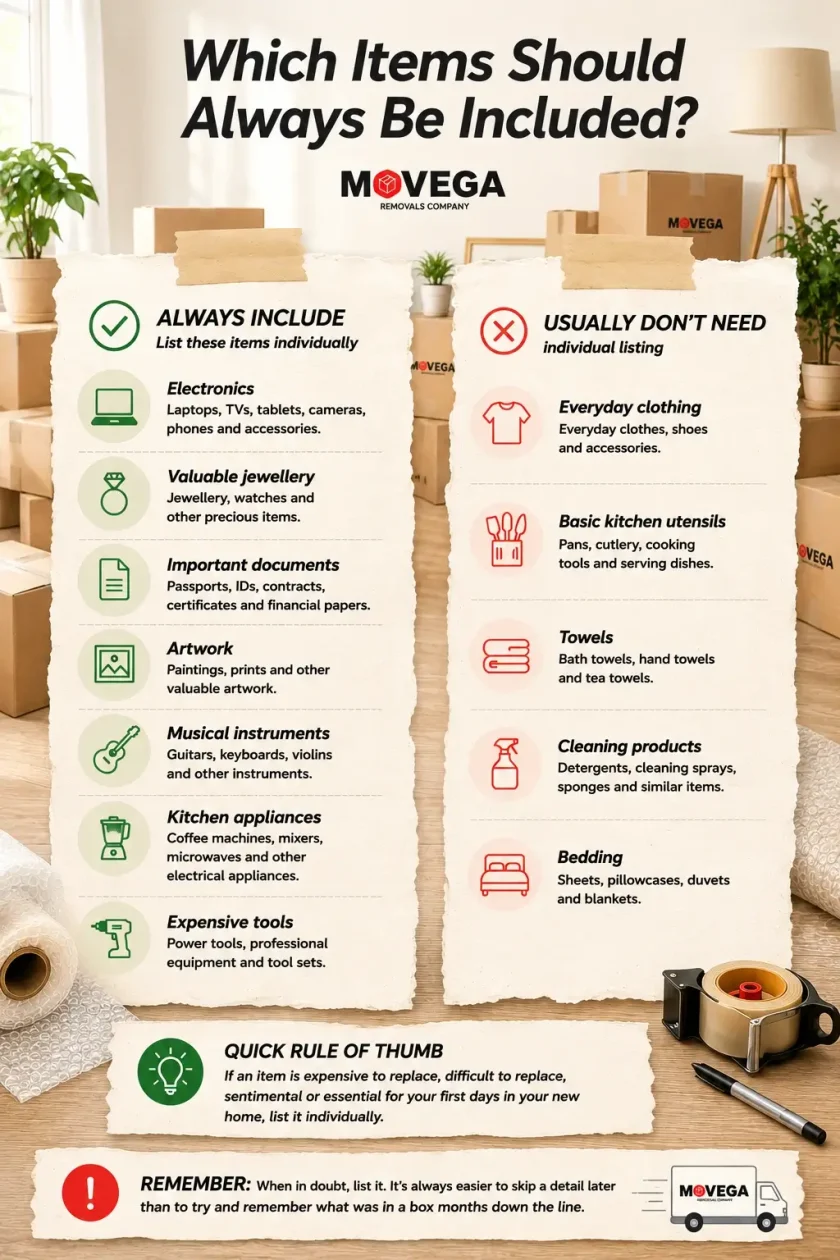
Every move is different, so treat these categories as a guide rather than a strict rule. If an item is particularly valuable or difficult to replace, it's usually worth listing separately. Remember, the goal isn't to create the longest inventory possible. It's to create one that's practical, easy to use and detailed enough to help you locate important belongings whenever you need them.
Record Valuable Items Separately
High-value belongings deserve a little extra attention because they're often the items that would be the most expensive—or impossible—to replace.
When recording these items, include more than just their name. Serial numbers, photographs, approximate values and, where possible, purchase receipts can all help you identify those items more easily and provide a useful record should you ever need it.
For example, instead of writing simply "TV", record the make, model and serial number. The same applies to laptops, cameras, gaming consoles, jewellery or artwork.
It's also worth taking a few photographs before packing. A clear photo showing both the item and its serial number can make identification much easier if you ever need to confirm the item's condition after the move.
If you're using professional movers, having this information ready can also make the check-in and delivery process much smoother.
Match Your Inventory to Your Box Labels
Your inventory and your box labels should work together. Every numbered box should have a matching entry in your inventory, allowing you to identify its contents without opening it.
Imagine receiving all your boxes at once. Finding "Kitchen – Box 12" on both the label and your inventory is much quicker than trying to remember whether "Large Box 4" contains plates, books or bathroom supplies.
The more consistent your labelling system is, the easier your inventory becomes to use. That's why it's worth deciding on a numbering format before you start packing and sticking to it throughout the move.
For example, you might label every kitchen box as K1, K2, K3, every bedroom box as B1, B2, B3, and use exactly the same references in your inventory. This simple system can save a surprising amount of time when unpacking dozens of boxes.
Paper, Spreadsheet or App?
There isn't one perfect solution. The best inventory is the one you'll actually keep updated throughout the move.
If you're moving from a one-bedroom flat with around 20 boxes, a simple notebook may be all you need. However, if you're relocating a four-bedroom family home with more than 100 boxes, a spreadsheet or inventory app makes it much easier to search, edit and organise everything.
Spreadsheets are particularly useful because you can sort boxes by room, mark fragile items, add notes and quickly search for specific belongings. Many families also share a Google Sheet, allowing everyone to update the inventory as they pack different rooms.
A paper inventory still has its place, especially if you prefer something simple. Just remember to take a photo of each completed page or keep a digital copy in case the notebook gets misplaced during the move.
Whatever system you choose, keep one digital copy stored in the cloud. If your notebook, phone or laptop becomes unavailable during the move, you'll still be able to access your inventory from another device.
For instance, a couple moving from London to Amsterdam may only need a handwritten inventory for around 20 boxes. By contrast, a family relocating from Manchester to Valencia with furniture, bicycles and children's belongings will usually benefit from a searchable spreadsheet that can be updated throughout the move. Ultimately, the right choice depends on the size and complexity of your move rather than the tool itself.
Moving Inventory Example
There's no single "correct" way to create a moving inventory, but the more specific your entries are, the more useful they'll be when it's time to unpack.
A vague description such as "Box 12" tells you almost nothing once the boxes have been stacked in your new home. A few extra details, however, can save a great deal of time and prevent unnecessary searching.
A practical inventory doesn't need to be complicated. Even a straightforward table like the example below can make unpacking much quicker. A practical moving inventory might look something like this:
|
Box |
Room |
Contents |
Fragile |
|
12 |
Kitchen |
Plates, bowls, mugs |
✓ |
|
13 |
Kitchen |
Toaster, kettle, coffee machine |
|
|
21 |
Bedroom |
Winter clothes |
|
|
34 |
Office |
Monitor, cables, keyboard |
✓ |
You can adapt this format to suit your own move. Some people also add a "Priority" column to highlight boxes they'll want to unpack first, such as kitchen essentials, children's belongings or home office equipment.
A little extra detail makes a huge difference when you're unpacking. Notice that the inventory doesn't list every individual plate or mug. Instead, similar items are grouped together while valuable electronics are described more precisely. That's usually the best balance between detail and practicality.
Common Inventory Mistakes
Even organised movers sometimes overlook small details.
One of the most common mistakes is writing "Miscellaneous" on several boxes. Three months later, when you're trying to find your extension leads or photo albums, that description won't be much help. Another easy mistake is forgetting to update the inventory after moving items between boxes. Even small changes can make the list inaccurate if they're not recorded straight away.
Other common mistakes include:
- using inconsistent box numbers or room names;
- leaving valuable items off the list;
- keeping the only copy of the inventory inside one of the moving boxes.
Keeping a digital copy on your phone or in cloud storage is always a sensible backup.
Frequently Asked Questions
No. Trying to list every single item usually makes an inventory harder to manage. Group everyday belongings together and reserve individual entries for valuable, fragile or particularly important items.
It's a good idea for expensive or sentimental items, particularly if they're difficult to replace. For example, if you're transporting a television, designer furniture or valuable artwork, taking a few photographs before packing provides an additional record of their condition.
If you've created a detailed inventory, sharing it with your movers can make unloading and checking your shipment much easier.
Not quite. Labels help you identify each box quickly, while an inventory tells you exactly what's inside. Used together, they create a system that's much easier to manage than relying on either one alone.
If you haven't labelled your boxes yet, read our guide on How to Label Moving Boxes the Right Way before moving day.
Final Thoughts
Creating a moving inventory might not be the most exciting part of preparing for an international move, but it's one of the most useful.
A few extra minutes spent creating a clear inventory before moving day can save hours of searching, unpacking and unnecessary stress once you've arrived.
A clear inventory helps you stay organised, protects valuable belongings and makes unpacking far easier once you arrive at your new home.
Combined with clear box labels, an Essentials Box and careful planning, it can make the entire moving process feel far less overwhelming.


