

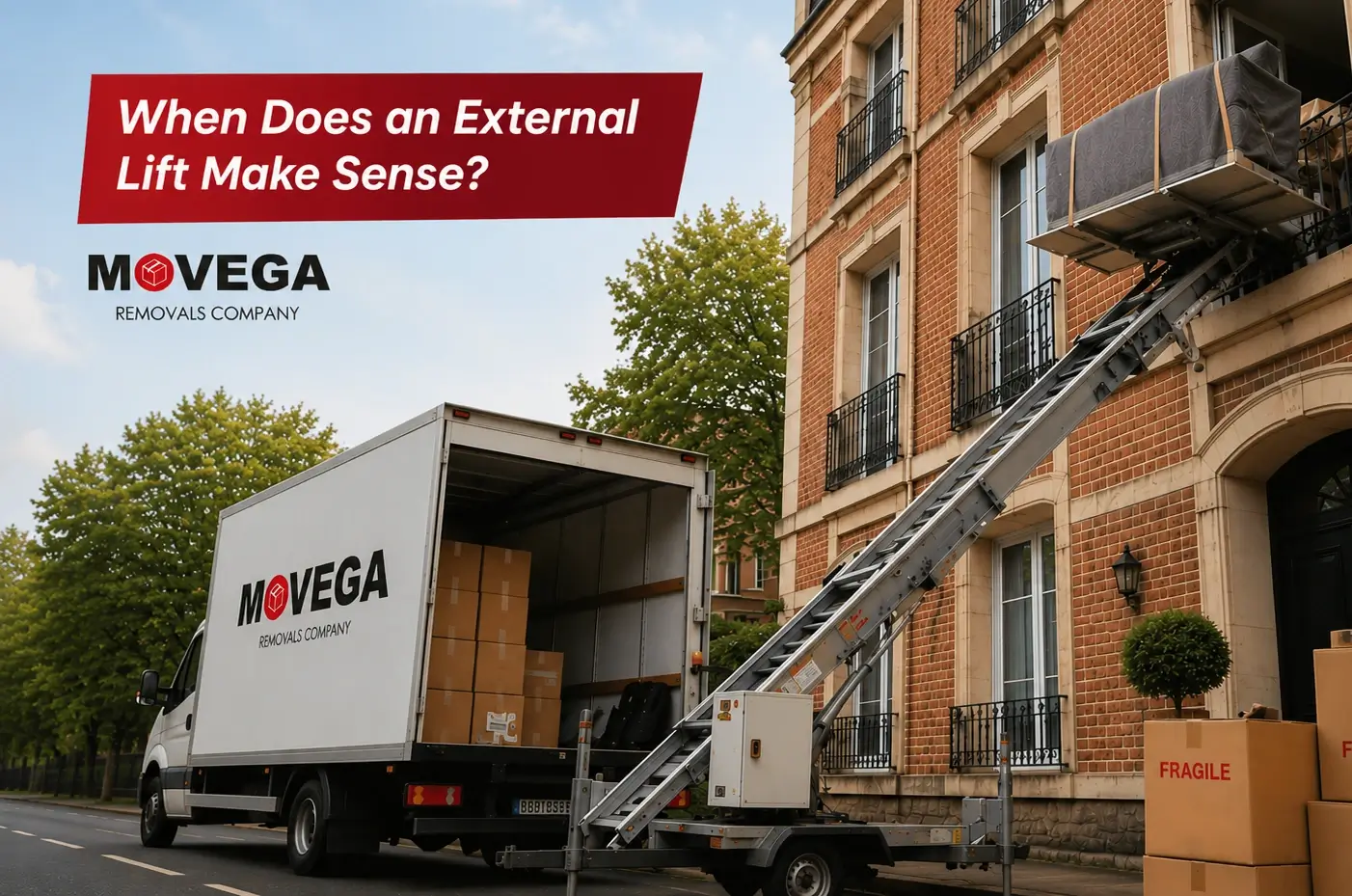
Most people do not think about an external lift until the move starts getting awkward.
That is usually the point where the staircase suddenly feels too narrow and the furniture feels far heavier than expected. What looked like a straightforward move quickly becomes slow, awkward and physically demanding.
An external lift solves a very specific problem: it creates a safer, more direct route for bulky items when internal access is poor. Not every move requires one, but in the right situation, it can save a great deal of time, reduce handling damage and make the entire process far less stressful.
At Movega, we use external lifts when they genuinely make the move safer and more efficient. They make sense when access is the real problem and when forcing everything through a staircase would create more risk than benefit.
The first clue is usually the staircase
If furniture has to be turned at awkward angles, lifted over tight landings or carried through narrow corridors, the property is already making the move more difficult than it needs to be.
Older buildings are the most common example. Victorian staircases, converted flats and upper-floor apartments often have layouts that were never designed with removals in mind. Even if the furniture technically fits, that does not mean it can be moved safely.
A staircase becomes a problem when:
- the turns are too tight for larger items
- the landings are too small for manoeuvring
- the walls are close enough to get scraped
- the furniture has to be tilted aggressively to pass through
- the item is too heavy for repeated manual lifting
In those situations, a removals lift gives the team a straight route instead of a fight with the building.
When the internal lift becomes more trouble than help
Many people assume that if a building has a lift, removals will be simple. That is often not true.
Passenger lifts are usually too small for large furniture, too slow for a full move and too fragile to be used repeatedly with bulky items. Even when the lift is technically available, it may not be practical for moving day. If access needs to be planned in advance, our guide on What to Do Before the Removal Team Arrives explains the key preparation points that make loading much smoother.
The problem usually shows up in one of these ways: the item does not fit, the weight limit is too low, the lift keeps getting shared with residents, or the loading process turns into endless back-and-forth trips. That slows everything down and increases the chance of damage.
A furniture lift removes that bottleneck. It is especially useful in apartment blocks where internal access is limited but there is a window, balcony or opening that can be used safely.
Large furniture is the real test
An external lift is rarely about small boxes. It becomes valuable when the move includes items that are difficult to handle manually.
Wardrobes, large sofas, American-style fridges, solid wood tables and tall bookcases often create problems not because they are impossible to move, but because the route inside the property is too restrictive. Tight staircases, narrow turns and small landings make large items much harder to manoeuvre safely, especially when they need to remain fully protected during the move.
The issue is not only weight. Size, shape and balance matter just as much. A heavy item can still be manageable if it is compact and easy to grip. A lighter item can still become a serious problem if it is oversized, fragile or awkward to angle through the building.
This is especially common with furniture that cannot be rotated safely indoors or pieces with delicate glass elements, uneven weight distribution or unusually large dimensions. In these situations, movers often spend more time trying to navigate the building than actually loading the item.
A fourth-floor flat with a narrow stairwell and a large wardrobe is exactly the kind of move where an external lift can save time and prevent damage.
A furniture hoist creates a more direct and controlled route between the property and the removals vehicle. If an item is difficult to carry, awkward to turn or vulnerable to impact damage, the lift often becomes the safer and more practical option.
Protecting the property can matter as much as protecting the furniture
One of the strongest reasons to use an external lift is not speed. It is damage prevention.
Internal moves put pressure on walls, railings, floors, door frames and shared corridors. In rented properties, that can become expensive very quickly. In apartment buildings, it can also cause issues with neighbours or building management if communal areas are scratched or marked.
An external lift reduces that risk because it keeps the heaviest and most awkward items away from the most vulnerable parts of the building.
That matters most when:
- the hallway is narrow
- the staircase has sharp turns
- the property has delicate finishes
- the move involves rented accommodation
- furniture needs to be carried over long internal distances
If the route inside the building is the thing most likely to cause damage, the better option is to avoid it.
It often makes more sense during international removals
International moves are far less forgiving than local ones.
When loading takes longer than expected, the problem does not stay inside the property. It affects transport timing, delivery windows, driver schedules and the overall coordination of the move. A delay caused by difficult access at the loading stage can create pressure across the entire relocation process, especially when the move involves long-distance transport between countries.
That is one of the main reasons external lifts are often more valuable during international moves than during local ones. They help the removals team work more efficiently from the beginning instead of losing time carrying heavy furniture repeatedly through narrow staircases, small lifts or restricted communal areas.
This becomes especially important in upper-floor properties, moves involving several large or awkward items and situations where loading needs to happen within a tighter schedule. In these cases, efficiency matters not only for convenience but for keeping the entire move running smoothly and predictably.
A move does not become better because it is physically harder. It becomes better when the right method is chosen early enough to avoid unnecessary complications later.
Why the right team spots the problem early
External lifts are not something that should be guessed at the last minute.
A professional removals team will usually assess the property before the move and look at the real access problems — staircase width, landing space, parking distance, window access, balcony access and item size. Those details usually reveal far more than a general description ever will. Good preparation beforehand, including professional packing & unpacking where needed, can make a big difference to how smoothly the loading process goes.
In practice, the warning signs are usually obvious:
- the furniture barely clears the internal route
- the property is high up with limited access
- the stairs are narrow or sharply angled
- the building layout creates avoidable risk
- the item is too large to carry comfortably by hand
If those conditions exist, the lift is often not an extra. It is the sensible solution.
When it is worth it, and when it is not
A furniture lift is not automatically the right choice for every move. Sometimes standard carrying works perfectly well and adding extra equipment would only complicate the job.
The decision usually comes down to access, item size and risk. If the move is simple, the staircase is manageable and the furniture can be carried safely indoors, an external lift may not be necessary. But if the route is tight, the items are large or the property is awkward to work in, the lift often pays for itself in reduced delays and lower handling risk.
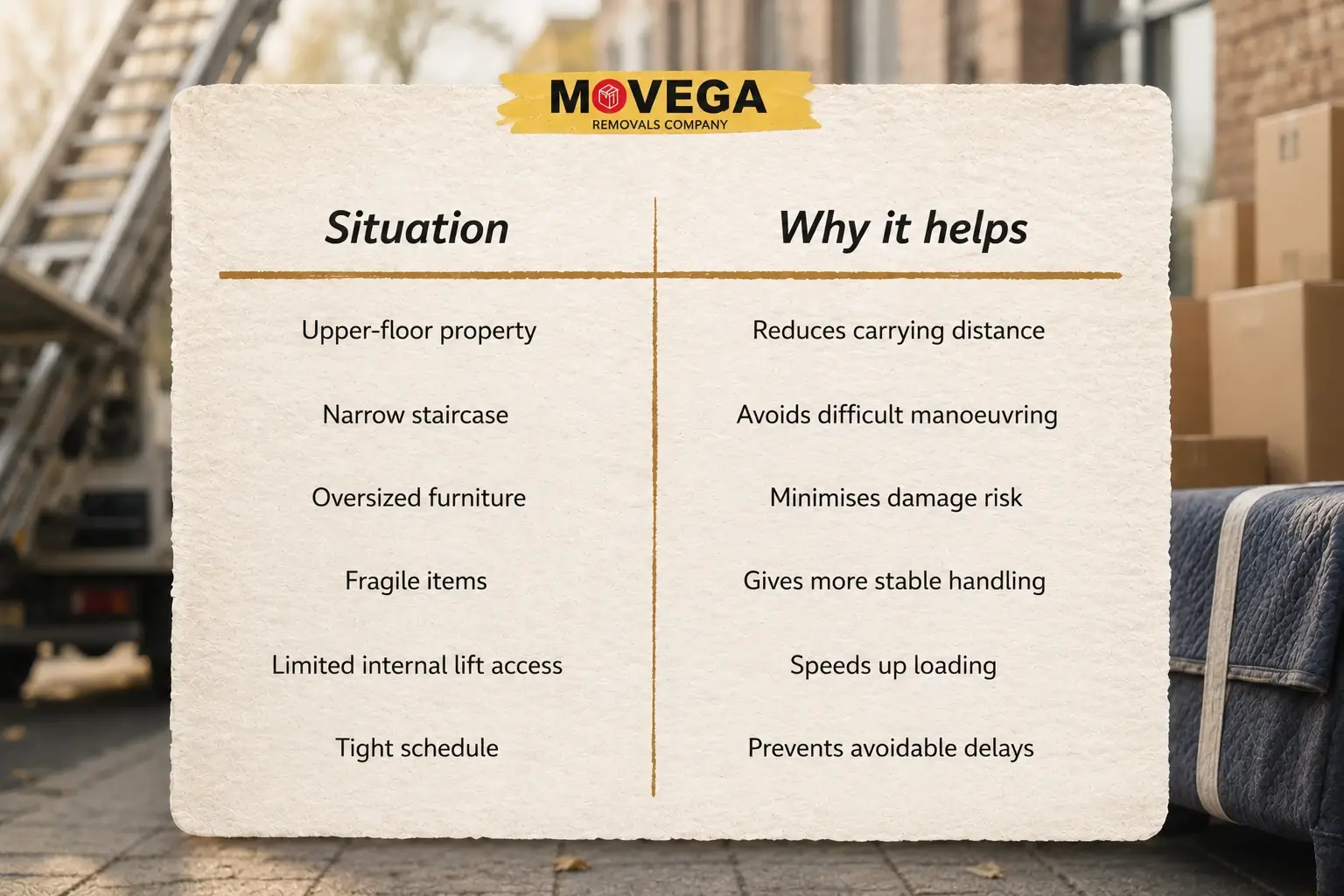
The real question is not whether the lift looks impressive. The question is whether it makes the move safer, simpler and more efficient.
The clearest sign you need one
If the team is likely to spend more time fighting the building than moving the belongings, an external lift is probably the better option.
That is the point of the equipment. It is there to remove pressure from the hardest part of the move. When used in the right situation, it protects the property, reduces handling strain and keeps the move running smoothly.
The smoothest moves are rarely the ones that require the most effort. They are the ones planned properly from the start and handled with the right equipment for the property.


