

Packing your belongings is only part of preparing for an international move. Even if every box is labelled and ready to go, unexpected access problems can still cause delays, additional costs and unnecessary stress on moving day.
A removal vehicle needs somewhere safe to park. Apartment buildings may require lift bookings or advance notice. Narrow staircases, restricted access roads and bulky furniture can all make loading more complicated than expected.
The good news is that most of these issues are easy to avoid with a little planning. Here's what to check before moving day to help everything run as smoothly as possible.
Check Access at Both Properties – Not Just Your New Home
When people think about access, they usually picture their new address. In reality, it's just as important to consider the property you're moving out of.
Take a few minutes to assess both properties from the perspective of your removals team. Is there enough space for your removal vehicle to park nearby? Are there narrow roads, low bridges or gated entrances that could restrict access? Will the team need to carry your belongings a long distance from the vehicle?
For example, collecting furniture from a house with a private driveway is very different from loading a third-floor flat in central London with resident-only parking and no lift. Although the distance between the two properties may be the same, the time needed to complete the move can vary significantly.
The more information you can provide your removals company in advance, the easier it is for them to plan the most efficient approach.
Don't Assume Parking Will Be Available
One of the most common causes of delays on moving day has nothing to do with packing – it's parking.
Just because you can usually park outside your home doesn't necessarily mean a removal lorry can. Residential permit zones, suspended parking bays, narrow streets or loading restrictions may prevent the vehicle from stopping close to the property.
Imagine the removals team arriving on time, only to spend the next 30 minutes searching for a suitable parking space. That extra distance means more walking, more carrying and a slower loading process.
If you think parking could be difficult, check with your local council or property management company well before moving day. In some areas, temporary parking permits or suspended bays can be arranged in advance.
💡 Quick Tip
If you're unsure whether a removal lorry can park outside your property, check the street using Google Street View before contacting your removals company. It's a quick way to spot narrow roads, height restrictions or limited parking that may affect access.
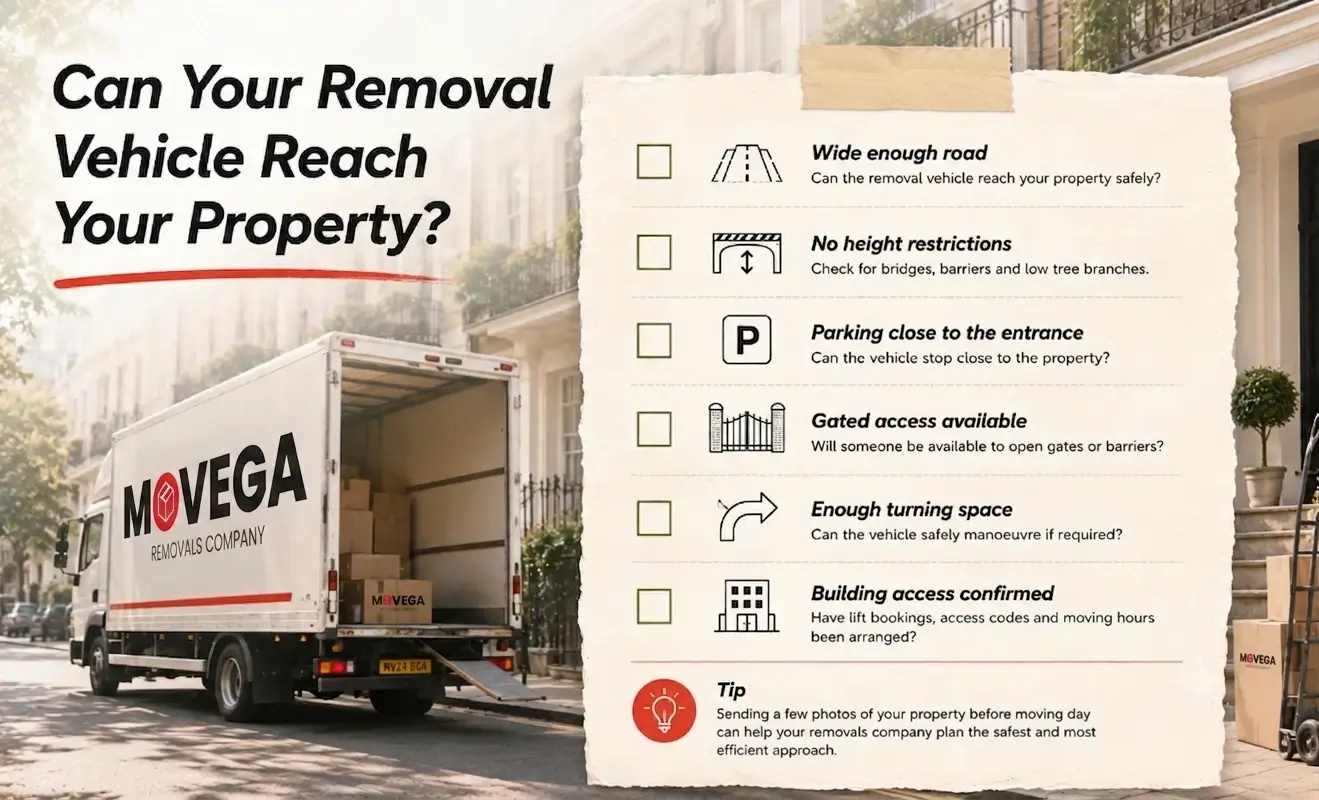
Before looking at building rules or measuring furniture, start with the basics. This simple checklist will help you identify the most common access issues before moving day.
Speak to Your Building Management Early
If you're moving from or into an apartment building, don't assume you can simply turn up on the day.
Many residential buildings have rules designed to protect communal areas and minimise disruption to other residents. Some require you to reserve the lift, while others only allow moves during specific hours or ask to be notified in advance.
It's also worth checking whether there are loading bays, security procedures or access codes that your removal team will need on the day.
For example, some modern apartment buildings only allow moves between 9 am and 4 pm on weekdays. Arriving outside those hours could mean waiting until access is permitted or rescheduling the move altogether.
A quick conversation with the building manager a week or two before your move can prevent a surprising number of last-minute problems.
A family moving into a modern apartment block in Manchester only discovered on moving day that the lift had to be booked 48 hours in advance. Instead of unloading immediately, they had to wait until building management approved access, delaying the move by several hours.
Before Moving Day: Building Access Checklist
Check whether your building requires any of the following:
□ A reserved lift for removals
□ Permission from the building manager or concierge
□ Access during specific moving hours only
□ A loading bay booking
□ Security or access codes for the removal team
□ Protection for communal areas (if required)
□ Parking arrangements for the removal vehicle
A quick phone call or email a week or two before moving day can help avoid unnecessary delays and last-minute surprises.
Measure More Than Just Your Furniture
Most people remember to measure large pieces of furniture.
Far fewer think about measuring the spaces those items need to pass through.
Before moving day, check the width of doorways, hallways, staircases and lifts, especially if you're moving bulky items such as wardrobes, American-style fridge freezers or large sofas. If you're still deciding how much you'll be taking with you, our guide on estimating your move volume more accurately can help you plan your move before measuring access points.
Imagine discovering on moving day that your sofa fits perfectly in the new living room but won't fit through the entrance to the building. Situations like this often lead to unnecessary delays and hurried decisions that could have been avoided with a few simple measurements.
When taking your measurements, don't forget to check corners and turning space as well. A sofa may fit through the doorway but still be impossible to manoeuvre around a tight landing.
If access is particularly restricted, an external furniture lift can often provide a safe and efficient alternative, allowing large items to be moved through a window or balcony instead of a narrow staircase.
Heavy Items Often Need Extra Planning
Not every item can be carried as easily as a moving box.
Pianos, marble dining tables, large safes, gym equipment and American-style fridge freezers often require additional planning because of their weight or size. These items often require more than just extra strength – they may also need specialist equipment or additional movers to handle them safely.
It's important to let your removals company know about these items before moving day rather than mentioning them when the team arrives. If you've already created a detailed moving inventory, it's much easier to identify valuable, bulky or unusually heavy items before moving day. This information allows your removals company to prepare the right equipment, allocate enough people and suggest the safest way to move them.
In some cases, arranging additional moving helpers can make loading significantly quicker and reduce the risk of damage or injury, particularly when access is limited or heavy lifting is involved.
Tell Your Removal Company About Any Challenges
Every property is different, and your removals company would much rather know about potential obstacles in advance than discover them on moving day.
Mention anything that could affect access, including narrow staircases, long walking distances, restricted parking, buildings without lifts or furniture that may need dismantling.
It's worth mentioning things such as:
-
- A fourth-floor flat with no lift
- Narrow staircases or tight corners
- Long walking distances between the property and the vehicle
- Restricted parking
- Large or unusually heavy furniture
- Access through a courtyard or gated entrance
Even details that seem minor can help the team prepare the right vehicle, equipment and number of movers, making the entire process smoother for everyone.
⚠️ Common Mistake
Never assume that something is "too obvious" to mention. Details like a narrow staircase, a long walk from the parking space or a building with no lift can all affect how your move is planned.
Frequently Asked Questions
It depends on where you live. If you're moving from a property with a private driveway, parking is usually straightforward. However, if you live in a busy town or city, particularly in a permit-controlled area, it's worth checking with your local council or building management well in advance. Temporary parking permits or suspended parking bays may be available in some locations.
A missing lift doesn't necessarily create a problem, but it's something your removals company should know before moving day. The higher the floor and the longer the carrying distance, the more time and planning the move is likely to require.
If particularly large furniture can't be safely carried through the building, an external furniture lift may be the most practical solution.
Absolutely. Even details that seem minor – such as narrow staircases, limited parking or long walking distances between the property and the vehicle – can influence how your move is planned.
Providing this information in advance allows the team to arrive with the right equipment, enough movers and a realistic schedule.
Yes. If you're moving particularly heavy or awkward items, additional moving helpers can often be arranged. Letting your removals company know in advance gives them time to recommend the safest and most efficient solution for your move.
Contact your removals company as soon as possible. Many access issues can still be managed if they're identified before the vehicle arrives, but the earlier they're discussed, the more options are usually available.
Final Thoughts
Preparing your belongings is only one part of a successful international move. Making sure your removal team can easily access both properties is just as important.
Checking parking arrangements, speaking to your building management, measuring access points and mentioning any potential challenges in advance can help prevent delays and make moving day far less stressful. Most access problems aren't difficult to solve – they're simply easier to deal with before moving day than on the day itself.
A little planning before moving day can save hours of unnecessary delays later. If you're unsure whether your property presents any access challenges, discuss them with your removals company as early as possible. A simple conversation beforehand can prevent unnecessary delays on moving day – allowing your removals team to focus on what they do best: getting you safely to your new home.


